Lincoln’s Adams Woods

A November walk.

We got out of the house around 10 and headed over to Lincoln to explore Adams Woods, a Lincoln Land Conservation property. It is about 100 acres in size and borders Walden Pond. The first challenge was finding a trailhead access point and a place where we could park the car. Talking to a guy raking leaves I find out it was just behind the sign that says “No Parking.” Once that was all behind us, and we got the boy in his carrier and on our back, we were on our way.
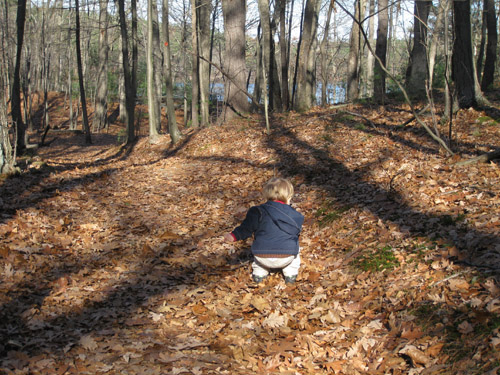
the boy and the trail
Walden Pond in the background

It was a beautiful fall day and the property, and the trails, were just great. The center of Adams Woods is fairly flat and level but around the edges there are some ups and downs around various water related features. To the south, and along what is roughly the boundary, is a trail that runs along what is called Heywood’s Brook. It ends at a meadow, which in turn looks out over Fairhaven Bay. To the northwest are Andromeda Ponds. These are a series of bog ponds that Thoreau visited and wrote about in his journal. This was not a far walk for Thoreau as the ponds and this property border the southwestern edge of Walden Pond.

There were a number of horses out and about on the trails, and even more runners, but all of our encounters with others were pleasant. The various water bodies and the related topography associated with them were really great. The New England woods in autumn are interesting enough but with all the leaves off the trees you could really see into some nice brooks, wetlands, and the bogs.

Some of the reading I did about Adams Woods in the “Guide to Conservation Land in Lincoln” says that things look much different here in the past. The small meadow stretched along the  whole length of Heywood’s Brook, for instance. It is also sure that this being Massachusetts that the forest throughout here has been reworked in many ways. This includes Thoreau and a friend starting a forest fire when they were cooking some fish.
Who is that?

What is black and white, lives underground for the majority of its life, is dependant upon vernal pools and mates in the fall?

The marbled salamander Ambystoma opacum. A wide ranging eastern US species, it reaches its northern limits in Massachusetts. The adults live in damp woods, often in close proximity to streams and ponds. They breed and reproduce in dried up vernal pools or other water ways that have lost their standing water. The eggs that are left under the leaves in September and October are left to hatch once the water returns. This may occur in the fall, with the larvae overwintering as active individuals that end up with a head start on other co-occurring salamanders that hatch in the spring. If rains do not fill the vernal pool where the eggs are, they can overwinter and will typically hatch in mid-March or April.

Black and White

The marbled salamander has striking black and white crossbands found along the tail, head and back.  The crossbands often run together and are broader on the sides of the body. This is for the males, at least. The females tend to have dull gray markings. Adults are typically stout and reach a total length of 8-12 cm. Females are slightly smaller than males.

Newly hatched juveniles possess bushy gills and dorsal fins that extend nearly to their front limbs.  Hatchling length averages 10-14 mm but may go as high as 19 mm.  The larvae are drab brown or blackish in color, and have a series of light spots that form a  thin line just below the level of the limbs.  Maturing larvae can become mottled with light yellowish-green coloration.  Adolescents are dark brown to black with light colored flecks, which changes into the adult pattern within 1-3 weeks after metamorphosis.

Lifestyle

Ambystoma opacumare predators that eat whatever it can find: worms, insects, slugs and snails. The can also be the top predator in some of the  temporary ponds they encounter. When they begin their life as a larvae the marbled salamander eats zooplankton but quickly add larger prey as they grow. These include crustaceans, aquatic insect larvae, other amphibians, snails and worms.

Manning State Forest, MA

Today the wife and I went for a ride to New Hampshire. On the way we stopped off in Billerica, MA and visited the Warren H Manning State Forest. There is a pull off into a small parking area off of Route 129. The parking lot has a building with bathrooms but they were closed. It was a bit of surprise to find both picnic tables and barbecue grills. I’m just not used to seeing those combos in state parks.That was not my only surprise.

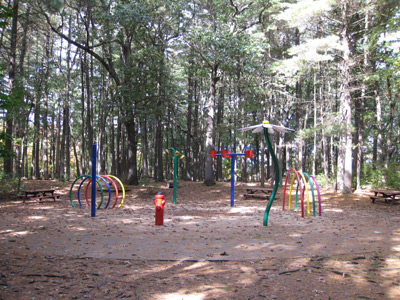
After heading down the path leading off the parking lot we quickly reached what seemed an unusual playground. Check it out….

manning-forest

It is a little tricky to see (I’m not the best photographer and the light was tricky) but there are a few scattered structures here. It turns out this is a small water park. The tall flower structure, which I was wondering how a kid might climb on it, is not to climb on but to splash down water. This was the same for each of the separate pieces.

The little bit of the forest we saw was not to exciting. A lot of pines which must have been planted long ago to replace the state’s forest timber harvest. Still, it was a beautiful part of a nice fall day and a walk in the woods is almost always a welcome respite.

Raccoons at the Door

I guess there are lots of stories like these as I know I have heard others tell me about their raccoon tales.

It was late in the evening, about midnight, and I was walking down the stairs that lead into the foyer. I could see out the front door window as I walk down and I saw the form of an animal just reaching the top of the outside steps.

I opened the front door to see a few raccoons. Fortunately there is a storm door so despite the fact they were a few feet from me it was just fine. As I was trying to adjust to my brain getting over the idea that “it must just be one of the neighborhood cats” and it just wasn’t, I noticed one of them was fishing around in a box right near the door. Our cat’s box of cat toys. Sitting on the porch because I was cleaning today but apparently I never brought it back in from the porch. Anyway it turns out one of them grabbed a small red ball, liked it, and proceeded to walk away with its prize.

I flicked on the porch light and opened the storm door a bit. I expected them to bolt in having all this happen. Just the opposite. Two of them (there were three, I found out) turned towards me and started walking towards the door. I closed it and they both came right up to the door, looking in the glass and not in the least bit perturbed. They acted as curiously as a cat and seemed like they wouldn’t have minded to have come in the house.

They did eventually wander off. Like a marauding band of hoodlums. Off to their next porch raid in search of more trinkets and, I am sure, hoping to find some morsels of food.

You can discover what other New England mammals you might expect to find, many of which will never end up coming to your front door for a visit.