There are few animals that provide us with stronger reactions than seeing a snake. A few are not worried at such a site but as E.O. Wilson writes in his book Biophilia it seems that we have a long evolved innate alarm response to these organisms.
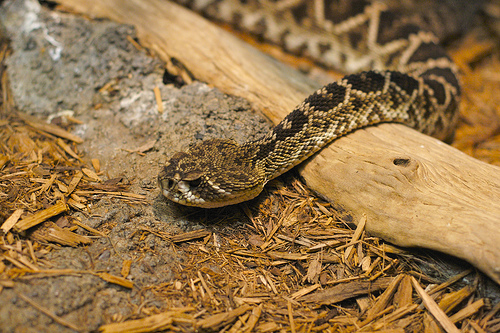
Of all the snakes that we could run into vipers can be pretty worrisome. Many have a form of venom that can cause severe pain, other problems such as the breakdown of tissues, and in some cases (and only from some snakes) death. They also look pretty fierce with eyes that have a pupil that is a vertical eliptical – in other words it is slit shaped. The vipers include snakes with cool names like the puff ader, the rock viper, the eastern hornsman adder and the black-spotted palm viper. Folks in the US are familiar with this group as the cottonmouth, copperhead and rattlesnakes are all from the large family of snakes, the Viperidae, that includes all the vipers.
All vipers have long hinged fangs. These can penetrate deep into our skin and are also designed as venom delivery devices, with the poison being injected as the fangs are sinking into whatever is being bitten. When retracted the fangs fold back into the roof of the mouth into an membranous sheath that is designed to keep them out of the way and safe from being damaged.
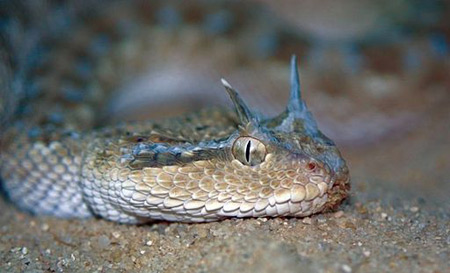
We think we have some fierce looking poisonous snakes in North America but there are a lot of interesting vipers found in other parts of the world. Here is one from the middle east. This snake lives in the desert and most, but not all, have horns on their head.
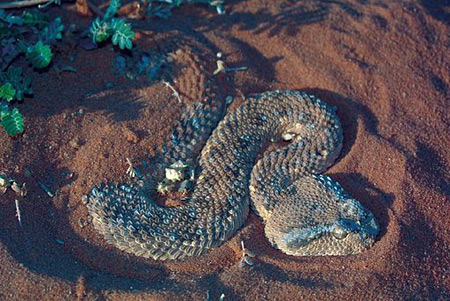
The picture above is the hornless form of Cerastes gasperetti. Below is the horned form.
Pictures shared under creative commons license. Please refer back to the original source, as given in the following, to see the original copyright and if you need to provide proper attribution for any of these images that you may wish to reuse elsewhere. Eastern Diamondback by poplinre. The last two are courtesy of: Stümpel N, Joger U (2009) Recent advances in phylogeny and taxonomy of Near and Middle Eastern Vipers – an update. In: Neubert E, Amr Z, Taiti S, Gümüs B (Eds) Animal Biodiversity in the Middle East. Proceedings of the first Middle Eastern Biodiversity Congress, Aqaba, Jordan, 20–23 October 2008. ZooKeys 31: 179–191