Equisetum

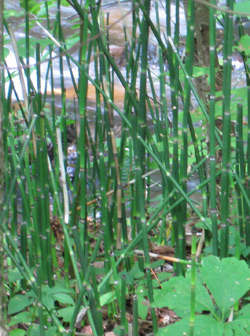
Thinly stalked Equisetum along a stream bank.

I found a nice patch of Equisetum in one of my walks the other day.

This plant is commonly found along the banks of waterways. I think this is a really cool plant because it was one of the first I remember learning about when I took botany in college. I came across a nice patch of these plants shortly after I was introduced to them. The genus is an ancient one and is the last survivor of the class Sphenopsida. These either are the first or among the first vascular plants. This class of plants were once among the most common and abundant plants on earth. This was prior to the emergence and evolution of the angiosperms.

Oil and coal that we use today is the product of plant material that includes plants from the Sphenopsida. During its heyday there were species from this class that grew as tall trees.

You can find out more about these plants and their history here.

Summer is Finally Here!

It is great how the weather of June and July has finally left us behind. The dog days of August are just not going to be that bad this year as we have suffered through so little heat this year. I just hope it is not a long cold winter as it will seem twice as long!

Not much to report. Just a short walk around the Rez today. With the sun and heat there were plenty of people the beach. The water in the Rez is thick with lots of vegetation. There is no doubt that it has accumulated so many nutrients and is choking on its own growth of water plants. I think the cooler weather also helped in the early summer. It did something to really stimulate  growth and contribute to the profusion.

Ipswich River Wildlife Sanctuary

Last weekend I went to the Audobon Ipswich River property. My first time there. It was a short visit, by design, so I was only able to begin to get a feel for the place. There were a few cool things of note.

There was a beaver lodge built onto one of the decks that was crossing some water/wetland. I have never seen a lodge built onto a man made structure like that before. It was also funny that the managers were obviously trying to save some of the trees from the teeth of the beaver. There were trees that were started into and then covered up at the base in chicken wire. Some trees were already shot, in that the beaver had already stripped the cambium of the tree all the way aroudn. I wonder if the chicken wire will work for the trees that were not already done for?

Another thing that I apparently just missed was some small bird being the meal for a hawk. There was a big pile of feathers on top of and underneath a picnic table right next to the main parking lot. It is crazy how many feathers birds do have, which is made abundantly clear when you see something like this just plucked bird meal.

the remnants of a hawks dinner

Dunback Meadow

Where:

Lexington, MA

What:

Town of Lexington Conservation Property

Size:

170 acres

Access:

The intersection of Allen Street and Pitcairn Place, Lexington.

The back of the ballfield behind the Bowman School, Lexington.

Features:

The conservators of the property include the following information about the property:

Dunback Meadow is the largest Conservation Property in Lexington. Clematis Brook flows through this property, eventually emptying into Beaver Brook in Belmont. The property’s diversified landscape consists of an extensive open meadow, red pine grove, community gardens, and a red maple swamp. From the time Lexington was settled, a section of this area was known as the Hunting Swamp, and it has included a portion where peat was cut for fuel, where cows were pastured, and where hay was cut.

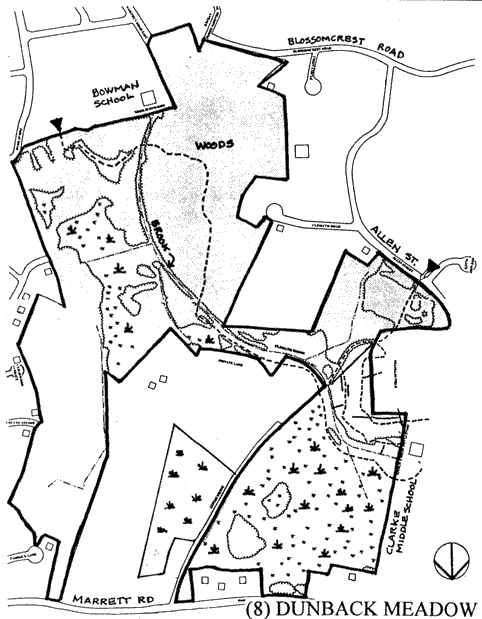
There are maps and photos found towards the end of this post.

A July 2009 visit

I spent an early afternoon, coming into the property from the Allen Street access. There is no parking lot but you can park along the side of the road. A small wooden sign marks the entrance.  The trail went downhill from the road and then skirted the edge of the community garden area. Continuing down the trail led through an area with high, dense brush. Following along on the northeast section of the trail led to the edge of a large wet meadow. The vegetation was largely high grass and other herbaceous plants, including lots of milkweed.

We eventually made our way to a second public access point for Dunback Meadow, which is located at the back of the Clarke Middle School ballfield. The trail crossed across a number of boardwalk areas and skirted along the edge of the meadow. We briefly talked to another person that come through on his bicycle. The gentleman told us he thought he had seen a fisher on the property a few weeks earlier.

Doubling back along our route, we then ventured into the wooded portion of the property. We crossed a small waterway and some old and new boardwalk areas of the trail. The mosquitoes were out in abundance in the woods, as we expected, and we did not dally long on this part of our trip.

The visit ended with our heading out of the woods, and up the hill to the street where our cars were parked.

Maps

a hand drawn map of the area that contains the Dunback Meadow
Topographic map of the area that contains the Dunback Meadow
This map is upside down in comparison to the hand drawn map just above it. The approximate location of the two official entrances and a third unofficial entrance are marked by the hikers in red.

Photos

the sign marking the entrance on Allen Street

The wooden sign at the Allen Street entrance to Dunback Meadow.

dunback meadow trail

The trail leading downhill from the Allen Street access.

community garden plots

A view looking into the community garden area.

the trail leading down from Allen Street

A scene from the trail.

the meadow

Looking across Dunback Meadow.

meadow trail boardwalk

One of the boardwalks found along the trails.

milkweed flower and a bumblebee

A bumblebee visiting a milkweed flower blooming in the meadow.

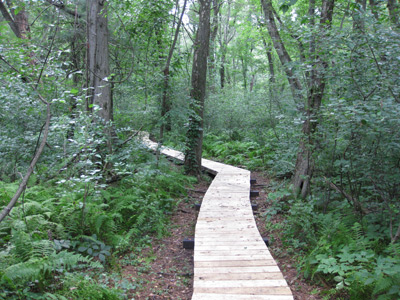
forest trail boardwalk

The newest boardwalk, crossing through the woodland area of the conservation property.